
Response to the EHRC consultation: addressing confusion around the Code of practice for services, public functions and associations
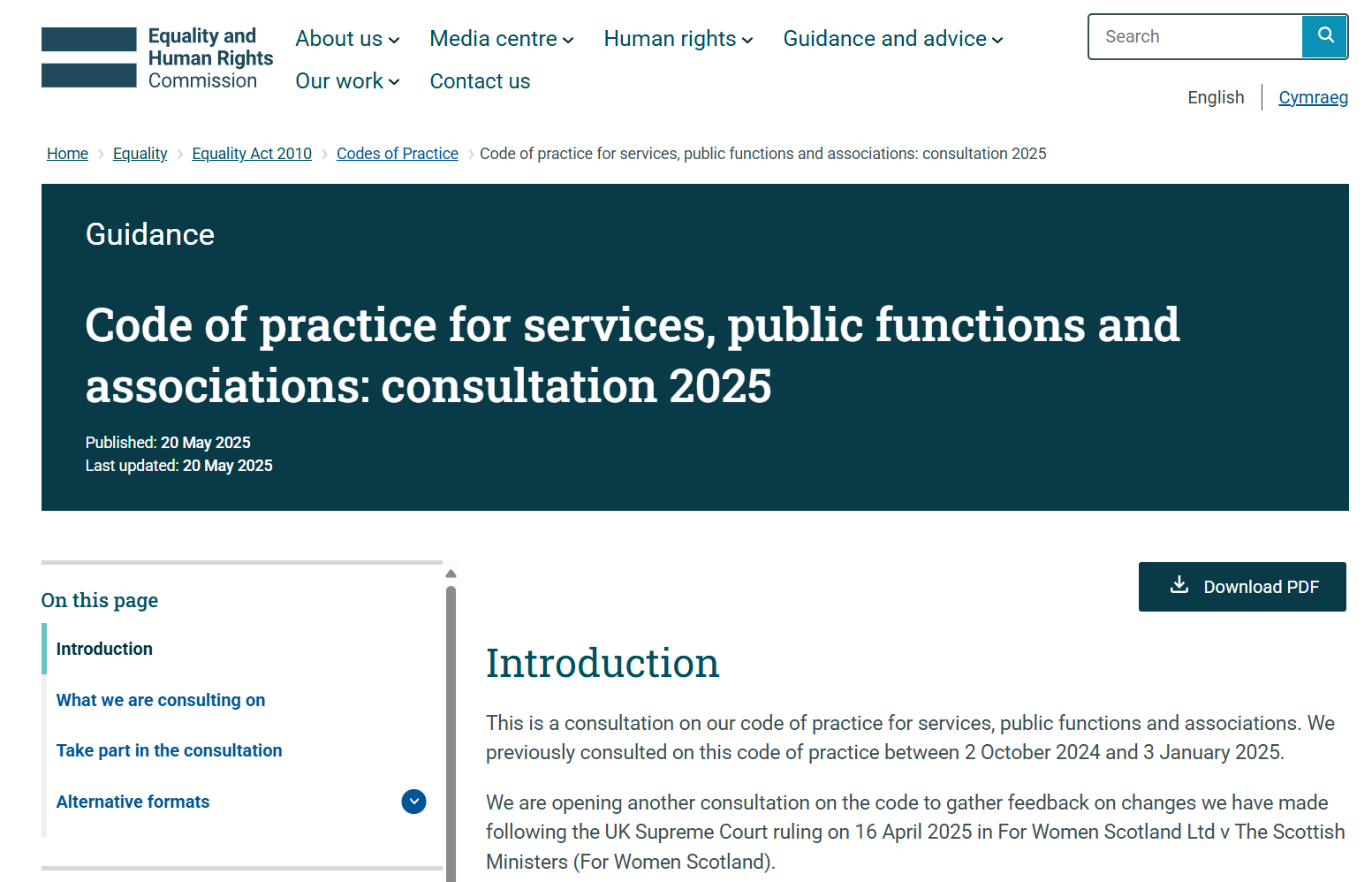
The Equality and Human Rights Commission’s consultation on its Code of practice for services, public functions and associations closes later today. The EHRC is only seeking comments on those parts of the Code which it has revisited in the light of the Supreme Court’s judgment in For Women Scotland vs the Scottish Ministers. We have provided some comments on the proposed changes (here). However, the main issues we wish to raise are about the introductory material to the Code and how the Code and changes to it are presented and described more generally. It was not possible to submit these comments using the consultation form, so we have sent them separately to the Commission. They are set out below.
Supplementary response to the EHRC
Summary of key points
- Part 1 of this additional response asks the Commission to consider carefully what the introductory material to the Code says, in the light of reactions to the judgment, and some commentary on the Code prior to that. Our comments are also relevant to any statements made by the Commission in relation to the Code, more generally. The Commission has a duty to ensure that readers understand that the Code does not substitute for the law, nor itself place new legal duties on organisations. The precise legal status of the Code should be described more prominently and carefully than at present.
- Part 2 notes that the requirements of the Equality Act 2006 mean that when the Code is contradicted by court rulings, as has happened in the case of FWS v the Scottish Ministers it cannot be immediately updated. In other words, its contents may guide organisations to act unlawfully, ahead of any corrections being made. While that remains the case, we suggest the Commission should ensure that information on relevant new caselaw is easily and obviously accessible on its website, and the Code itself needs to include a clear warning for users to check there for information on where the Commission believes statements in the Code can no longer be safely be relied on.
- Part 3 sets out general principles related to its detailed content, which follow from the points above. Some of the proposed changes are straightforward and helpful, assessed against those principles. However, there are parts of the Code where the material is unclear, lacks an obvious basis in law or, at worst, suggests that the law says things it does not.
Introduction: the historic role of the Commission
We note that in a letter to the Commission dated 13 June, Scottish Trans object to “pretending… That it is organisations like ours, and trans people, who have somehow imagined that for the last fifteen years all Governments and the EHRC have told us that trans people are able to use single-sex services in line with their gender identity, unless limiting or modifying their access to, or excluding them from, such services is a proportionate means of achieving a legitimate aim.” They make an important point.
In 2011 detailed material was added to the Code, after the formal consultation concluded. This material, which was never consulted on, wrongly suggested that a provider not only could, but in some circumstances should, as a matter of policy, admit some members of the opposite sex to single- or separate-sex services. The history of how these changes were made has been included in more detail in the submission already made to the Commission by Sex Matters.
As we note below, the material added at the last minute in 2011 led to a strongly-held belief in some quarters that the law says something that the Supreme Court has now confirmed it never did: that some people have the right to self-identify into opposite-sex spaces, services and activities, and that spaces, services and activities which exclude all members of the opposite sex are always or almost always unlawful. We believe that the EHRC ought to acknowledge and apologise for its historic role in creating substantial misunderstanding here, as part of moving matters forward.
Also, it must avoid making the same mistake again, in a new way. The Code in its current draft still shows signs of the sort of errors of law that the Commission allowed at a late stage in 2011, particularly in Chapters 2 and 13. Much of this would be better dealt with by simplifying and cutting back the content, rather than by trying to amend or elaborate further on material in the current Code that cannot stand, following the judgment. It is time to put this episode in the Commission’s history properly behind it.
Part 1: Clarifying the Code’s status
What the code is
Under s14(1) and (2) of the Equality Act 2006 the EHRC is empowered, but not obliged,[1] to issue a code of practice in connection with any matter addressed by the Equality Act 2010, to ensure or facilitate compliance with the Equality Act 2010 or an enactment made under that Act, or to promote equality of opportunity. Codes issued under this section are subject to further process in parliament. They are generally referred to as statutory codes.
The Statutory Code covered by this consultation covers discrimination in services and public functions, as set out in Part 3 of the 2010 Act, and discrimination by associations. In line with Section 29 in Part 3 of the Act, this covers any service provided publicly or privately, whether that service is for payment or not. The Commission has separate Statutory Codes on Employment and Equal Pay that it is not currently proposing to change.
How it is currently explained
Although laid before Parliament, the Code is not itself law.[2] As the current Code explains (emphasis added):
The Code does not impose legal obligations. Nor is it an authoritative statement of the law: only the courts and tribunals can provide such authority. However, the Code can be used in evidence in legal proceedings brought under the Act. Courts and tribunals must take into account any part of the Code that appears to them relevant to any questions arising in proceedings. If providers of services, those exercising public functions and associations follow the guidance in the Code, it may help them avoid an adverse decision by a court in such proceedings. (Paragraph 1.5)
Evidence of misunderstanding prior to the Supreme Court judgment
Prior to the 16 April, the status of the Code was already being wrongly understood. Our own experience here illustrates this misunderstanding being adopted by senior relevant professionals.
In 2019, we published an article, Losing Sight of Women’s Rights, in the journal Scottish Affairs. We argued that organisations had run ahead of the law by replacing sex with self-declared gender identity in various contexts. We argued that the Equality Act did not provide for self-declaration into opposite sex categories, an interpretation later confirmed by the Inner House of the Court of Session in 2022, and more recently by the Supreme Court.
A forceful response to this article, also published in Scottish Affairs, condemned us for making this argument, at all. We later described this response as “seek[ing] to place our particular view of the law beyond academic respectability” and containing “in a scholarly context, unusually strongly worded criticisms of our position on the law.” We noted that “Cowan et al. are very critical of our perceived failure to refer to the EHRC ‘Statutory Code of Practice: Services, Public Functions, and Associations’ … The contents of the Code appear central to Cowan et al.’s interpretation of the law and to their objection to us presenting a different view. They describe it three times as ‘authoritative’ (a term used also by Busby).”[3] The (mis)understanding of the status and purpose of the Code evidenced here was among senior academics, based in law and social policy, and a practicing lawyer in a relevant field.[4] This should concern the Commission.
Evidence of misunderstanding since the Supreme Court judgment
Over the past two months, we have seen multiple examples of this consultation being used as a reason to the treat compliance with the judgment as optional for the time being, or as premature. These include observations that the judgment only comes into force with the Code, that the Code is the law but the judgment is not, that the Commission rather than the court interprets the law, and that organisations cannot safely take their own view on the application of the law without it. This sort of misunderstanding extends to people with relevant professional background in a way which should, again, concern the Commission.
For example, in the last few days, a number of groups have written to the Council of Europe, referring to “draft guidance which seeks to make such an approach statutory… The draft guidance, were it to become law, would impose an obligation on employers and service providers…”[5] (emphasis added). This basic misunderstanding of how legal obligations arise and the status of the Code has been subscribed to by, among others, a well-established advocacy organisation in Scotland funded mainly by the Scottish Government, which now includes on its board a civil servant with relevant past experience in this area, and another group which includes senior academics.
Of particular concern to us, the Scottish Government has repeatedly referred to delaying acting on the judgment, beyond internal discussions and preparation, until the new Code is available. For example, it has used this as a pretext for declining to withdraw its policy on housing some men in women’s prisons, or its guidance for schools, which is also in conflict with a recent, separate, relevant ruling in the Inner House of the Court of Session on the School Premises (General Requirements and Standards) Regulations 1967. On 17 June, Jenny Gilruth MSP, the Cabinet Secretary for Education, appeared to go as far as suggesting that local authorities need not act on that judgment until the revised Code is available.[6] Its Permanent Secretary rested heavily on waiting for the revised Code when in front of a Scottish parliament committee on 24 June, saying “relevant officials” had advised this approach. A Scottish Government official told women’s groups in a meeting on 5 June that the EHRC had told it to take no action until the revised Code is available. For Women Scotland has now raised this with the Permanent Secretary, after the Commission expressed concern that its conversations with the Scottish Government had been misrepresented.[7]
Further, some employers, including the Scottish Government, considering only their responsibilities as employers, are arguing that they need to wait for the revised Code. This makes no sense. The Code deals with only with services provided publicly or privately (Equality Act 2010, Part 3), and associations. Employment is covered in Part 5 of the 2010 Act. The separate Statutory Code on Employment includes material on washing and changing facilities, but is silent on the questions considered in the two cases brought by For Women Scotland. There has been no suggestion that employers have been unable to act without that, since 2010. Nor are we aware of calls since April to revise this Code.
The Scottish Government has a large Legal Directorate which specialises in public law. Its own obligations as an employer are not covered by the Code under consultation. The position it is taking, given this and the discussion above of the Code’s status, is plainly absurd. It will nonetheless be influencing public bodies in Scotland, and others.
Dealing with this misunderstanding
Given the scale of misunderstanding surrounding the Code, before and after the Supreme Court judgment, what Section 15(4) means, and does not mean, should be explained more emphatically and clearly than in the current version, for the benefit both of lay readers and those with a legal background.
This could be achieved mostly through changes to layout and ordering, adding emphasis (such as highlighting the first two sentences of para 1.5) and some reinforcement of the existing wording, including a direct citation of Section 15(4).
For example, the Code might be even more explicit than it already is that it does not provide a guaranteed defence against breaches of the Equality Act 2010, given that the courts will decide how far its content is relevant in any case. Stating in terms that it does not substitute for organisations taking their own legal advice would be helpful, as might be highlighting the word ‘may’ in the last sentence of paragraph 1.5.
Astonishingly, it is also clearly necessary to state in the Code that relevant decisions in the courts related to the Equality Act made after the Code is adopted will come into immediate effect, and are not dependent on being included in a revision of the Code to do so.
Should the Code be rejected by ministers, or voted down when placed before Parliament, as some lobby groups and MPs are arguing should happen, or be subject to a successful legal challenge, it would have no effect on duty bearers’ obligations under the law. The Commission should make this clear when it puts forward the final version of the Code for ministerial and parliamentary approval. That the law would continue to stand by itself, even if any part of the Code were reduced in the courts should also be stated in terms in the Code itself, as part of the Commission’s duty to make sure that duty bearers looking to the Code are not vulnerable to any misinformation on that point.
Unhelpfully, there is a prominently-placed misleading statement in the Chair’s introduction to the Code from 2011 (emphasis added), “This is the authoritative, comprehensive and technical guide to the detail of law.” This confusingly and incorrectly directly contradicts para 1.5 and Section 15 of the 2006 Act. No such statement should be included in the reissued Code. The introduction to that, and all statements made about it, should be subject to careful scrutiny.
In a statement on 6 June, the Commission said “the EHRC has a clear statutory duty to provide authoritative guidance on the law following the Supreme Court’s decision” (emphasis added). Again, this misdescribes the effect of Sections 14 and 15 of the 2006 Act. The Commission itself needs to be more alert to its own role in creating misunderstanding about its own powers and duties, and the Code’s status, and the creation of excessive dependency on the Code.
The only strict duty on the Commission here is the general one that would apply to any public body, to withdraw any incorrect advice it has issued, and to take whatever action is required to make sure that it is well-understood by duty bearers that some of its previous advice was wrong in law. Beyond that, the Commission is only making decisions about the extent to which it wishes to exercise the powers available to it. As noted below, Section 15(3) of the 2006 Act gives the Commission the power to ask the Secretary of State to withdraw any Statutory Code; there is no obligation placed on the Commission to replace a withdrawn Code.
The Commission should also clarify in this Code and elsewhere that it has a specific scope, and does not cover all circumstances where the meaning of sex in the Equality Act is relevant, including employment.
Part 2: Addressing the inflexibility of the Code
The Code requires to go through a formal process, involving the Secretary of State and Parliament.
A Code issued under Section 14 may be revoked by the Secretary of State, at the request of the Commission, by order (under Section 15(3)) but there is no provision to amend it, or to revoke only parts of it in this way. On 16 April, it was put further beyond doubt that several parts of the current Code are in direct conflict with the Equality Act 2010. The Commission itself had no power to withdraw or suspend these, however, and they may remain part of the Code for several more months.
The Commission has added a note to its website and to the Code that “Following the UK Supreme Court ruling on 16 April 2025 in For Women Scotland, this Code of Practice is under review. An updated version is currently being consulted on.” This appears to be the limit of what the Commission can do, other than making the note more specific, for example, by adding direct references to the affected sections.
The process for reacting to court rulings is therefore slow, resource intensive and not under the full control of the Commission.
As long as the basis for the issuing the Code remains as set out in the 2006 Act, the Code itself should include a prominent health warning that its contents are subordinate to any developments in the courts. This should advise readers to check the relevant section of the Commission’s website for advice on any relevant developments in caselaw which mean that elements of the Code can no longer be relied on in court. The Commission should ensure that information on relevant new caselaw is easily and obviously accessible on its website, and its relevance to specific parts of the Code clearly explained.
Further, the Code should warn readers that neither the Commission nor the Secretary of State are under a legal duty to keep the Code up-to-date, so that its existence does not remove the obligation on providers to consider for themselves relevant legal developments.
This point became apparent after the ruling of the Inner House in the first case brought by For Women Scotland, in February 2022. No action was taken to amend the Code to deal with the parts that conflated sex and gender reassignment (leaving aside the separate issue of the effect of a GRC). Even when consultation on a revised Code commenced last October, parts of the text remained in conflict with that ruling, which was not cited. We noted in our response in January this year that:
At various points, the EHRC draft CoP however simply repeats the position in its existing CoP, issued prior to the 2022 judgment. It states that providers not only may, but sometimes must, act as though the characteristic of gender reassignment changes a person’s sex under the Equality Act.
The draft EHRC CoP therefore appears to be placing pressure on providers in Scotland to ignore a relevant and definitive ruling of the Inner House of the Scottish Court of Session, by giving certain men, as defined under the Equality Act, rights of access to activities and services being lawfully provided under that Act for women only; and to be ignoring the ruling itself, by arguing that such providers are required to justify the exclusion of certain men from women-only provision, based on anything other than their sex.
Given the evident conflict between the ruling and the EHRC’s proposed revised CoP, the EHRC ought to publish the detailed legal reasoning that informs the draft on this point, as a matter of urgency. As matters stand, this conflict creates potential risk and confusion for providers and service users in Scotland, and beyond. The lack of any reference to [2022] CSIH 4 P697/20, and absence of any discussion of its implications, will moreover have left those responding to the consultation, particularly from Scotland, lacking relevant information to which they were entitled. Early sharing of the EHRC’s detailed legal analysis here, and allowing additional time for supplementary responses in the light of that, would help to address this significant omission.
If the Commission had reacted more quickly and clearly to the 2022 ruling, we believe that the backlash to the Supreme Court’s ruling would not have been so intense. Much of it clearly relates not to the matter of the case (the effect of GRCs) but to the agreed position of all parties, including the EHRC, at the outset of the case, that absent a GRC, sex in the Equality Act is a matter of biology, not identity. The acute distress and shock felt by some people at the Supreme Court’s ruling could have been moderated and better managed, had the EHRC moved to redraft the Code in 2022.
Part 3: Proposed alterations to the Code
Given its status, the Code’s contents should be focussed on helping organisations to understand better the options open to them which would be clearly within the law. As a matter of principle, it should avoid appearing to create new directives which are not clearly founded in existing statute or caselaw and should avoid content in obvious conflict with either.
The purpose of the Code is to make the law, as it stands, easy to understand and implement. It should not be used as a site of activism or proxy legal innovation. If there are conflicts within the Commission about what the law means, these arguments should not be played out in the Code. The draft shows some sign of this, for example in Chapter 13. Where the Commission believes the law is unclear or leaves gaps, especially where it anticipates a point might be contested, it should not suggest certainty or offer reassurances which it is not placed to give, however much some staff may wish to. If there are unresolved matters or gaps the Commission feels obliged to note, it should be clear and precise about what those are; however, the Code should in the main keep to areas where the Commission is confident about the help it can give to duty bearers. The backlash to the Supreme Court judgment shows how damaging it can be, if the Code is used to try to legislate by the backdoor, as happened in 2011.
The Commission should be confident that the Code’s contents could be defended in court and will not put providers who follow it at legal risk. That approach ought to help the Commission defend its choices during the governmental and parliamentary part of the Code’s adoption.
Given experience here, wherever the Code uses imperatives (should/ought etc) it should tie these statements back, with citations, to their legal grounds. We have responded separately on the new content from that perspective. That approach leads to us to the conclusion that both Chapter 2 and Chapter 13 in particular contain material that risks misleading and confusing readers and leaving duty-bearers exposed to legal risk. Much of this could be addressed reasonably easily, by amending or omitting material. The section on sport in Chapter 13, however, requires substantial changes for accuracy and clarity. As currently drafted, it looks very likely to expose users, and by extension the Commission, to legal risk.
[1] The language is “may” not “shall”.
[2] Section 15(4) of the 2006 Act states that failure to comply with a provision of a code shall not of itself make a person liable to criminal or civil proceedings, but that its content may (emphasis added) be taken into account in legal proceedings.
[3] From our response to Cowan et al, Losing Sight of Women’s Rights (Again).
[4] The lead author, Sharon Cowan, is a professor in the Law School at the University of Edinburgh, another author is now a professor in the University’s School of Social and Political Science (Dr Meryl Kenny), another is a Chancellor’s Fellow in the same school (Dr Rebecca Hewer) and a fourth is a practicing solicitor with a background in employment law (Sean Morris). We refer also to Professor Nicola Busby, based in the School of Law at the University of Glasgow.
[5] https://bsky.app/profile/transsolidarity.bsky.social
[6] https://www.scotsman.com/education/scottish-schools-told-to-wait-for-guidance-on-single-sex-toilets-after-supreme-court-ruling-5181734
[7] Letter to Permanent Secretary – For Women Scotland