
The threat to domestic violence support services for women in Edinburgh
Introduction
This blog looks at a recent threat to funding provided by the City of Edinburgh Council to Edinburgh Women’s Aid (EWA). This arose from an objection to EWA’s decision to restrict its group services (refuges and therapeutic groups) to women, and to exclude all men, however they identify.
We show that City of Edinburgh Council (which provided 40% of EWA funding in 2023/4) has, in the last ten years, received no bids for funding from organisations offering services for men or for those with transgender identities who have experienced domestic violence. It also holds no data on the need for such services for those with transgender identities.
We conclude that the funding challenge to EWA has no evidence base, and further threatens vital services for women in the city, based on the well-established need for single-sex provision for women subject to domestic abuse.
Funding threat to Edinburgh Women’s Aid
In March this year, Scottish Greens councillor to the City of Edinburgh Council Alex Staniforth, tabled a motion for debate at the full Council meeting scheduled for 20 March.
The motion noted that Edinburgh Women’s Aid “do not allow trans women [trans identified males] – even those with a Gender Recognition Certificate – into their group therapy or refuge spaces”. For that reason, Cllr Staniforth’s motion demanded that the Council “review its future SLAs [Service Level Agreements] and contracts with service providers offering support to people facing domestic abuse and sexual violence to make it clear we expect services to be fully trans inclusive”.

The motion appeared to be a response to a statement published on the Edinburgh Women’s Aid (EWA) website, as shown below.
Edinburgh Women’s Aid position statement
We are working toward a society that is free from domestic abuse. Until we can be free of this intolerable and unacceptable violence, we are here to support the women and children who are affected.
We work within the Scottish Governments Violence against Women and Girls Strategy (Equally Safe) and recognise domestic abuse as part of the spectrum of men’s violence against women. We acknowledge it occurs in non-heterosexual relationships, and can be
perpetrated by women against men. However, evidence shows that it is overwhelmingly perpetrated by men against women. Our services were developed by women, for women who are affected by domestic abuse in Edinburgh, and this is where our expertise lies.
We also work to the Scottish Government’s definition that domestic abuse is perpetrated by a partner or ex-partner. We recognise that other family abuse exists, but our specialism is in domestic abuse, and this is the work we are funded and contracted to deliver.
Everything we do is focused on supporting women who have faced violence and abuse in the best and safest way possible. This includes providing an environment where women feel safe while mitigating any risk of them being further traumatised as they seek the help they need and deserve.
It is important that anyone who has experienced domestic abuse has somewhere to turn. We provide a supportive and empathic response to anyone who contacts us, this can include signpostng to the most appropriate service for their needs. We provide telephone, court and drop-in support to any woman who contacts our service.
We recognise that there are differing views on sex and gender, which are protected by the Equality Act 2010. We also respect there is a broad range of beliefs on these topics within our staff, board and the women we support. We recognise the rights of women to hold and express differing beliefs in society. However, as an organisation we do hold specific positions in regard to our service provision and employment.
In terms of our service provision, Edinburgh Women’s Aid applies Schedule 3 (Part 7) of the Equality Act 2010, which contains a number of exceptions to the general provisions on nondiscrimination, including that a trans person can be excluded from single sex services when it is a proportionate means of achieving a legitimate aim. Therefore, we lawfully exclude transgender women and males who have transitioned to non-binary (including those with a GRC) in our adult groupwork services and in our shared refuge spaces, including our 24-hr refuge.
In terms of our employment, Edinburgh Women’s Aid applies Schedule 9 (Part 1) of the Equality Act 2010 to our recruitment process. This schedule allows discrimination on the basis of gender reassignment, and therefore we lawfully exclude transgender women and
males who have transitioned to non-binary (including those with a GRC).
We recognise that legal provisions can change and will regularly review our position and practice accordingly.
A blanket ban?
Ahead of the meeting, Cllr Staniforth, who describes himself as non-binary, said “If there is a blanket ban on trans people accessing the service that is not acceptable” and “it would be completely inappropriate for a [trans woman] to try to access men’s services”, claiming “we wouldn’t allow any other minority women [sic] to just be cast aside completely like that”.

In the same article, he went on to say: “If we could find someone who was providing that same service, but trans-inclusive, we should definitely favour that service, split the funding with the trans-inclusive service and reduce funding for Edinburgh Women’s Aid.”
He also said that he believed service users should be assessed on a ‘case-by-case basis’, something which veteran campaigners on violence against women and girls have dismissed as neither practical nor desirable.
(Not a blanket ban)
It is important to be clear that the group Cllr Staniforth is concerned about do not face a blanket ban from the service. They continue to have access to individual counselling and single-occupancy accommodation. The only services that all male people are excluded from are those where they would be interacting with women receiving support from EWA.
Opposition to the motion
Unsurprisingly, the move to defund a women-only service that has existed in the city for five decades was met with strong opposition from grassroots women’s groups. Along with For Women Scotland, we commented in an article in The Times on 3 March.
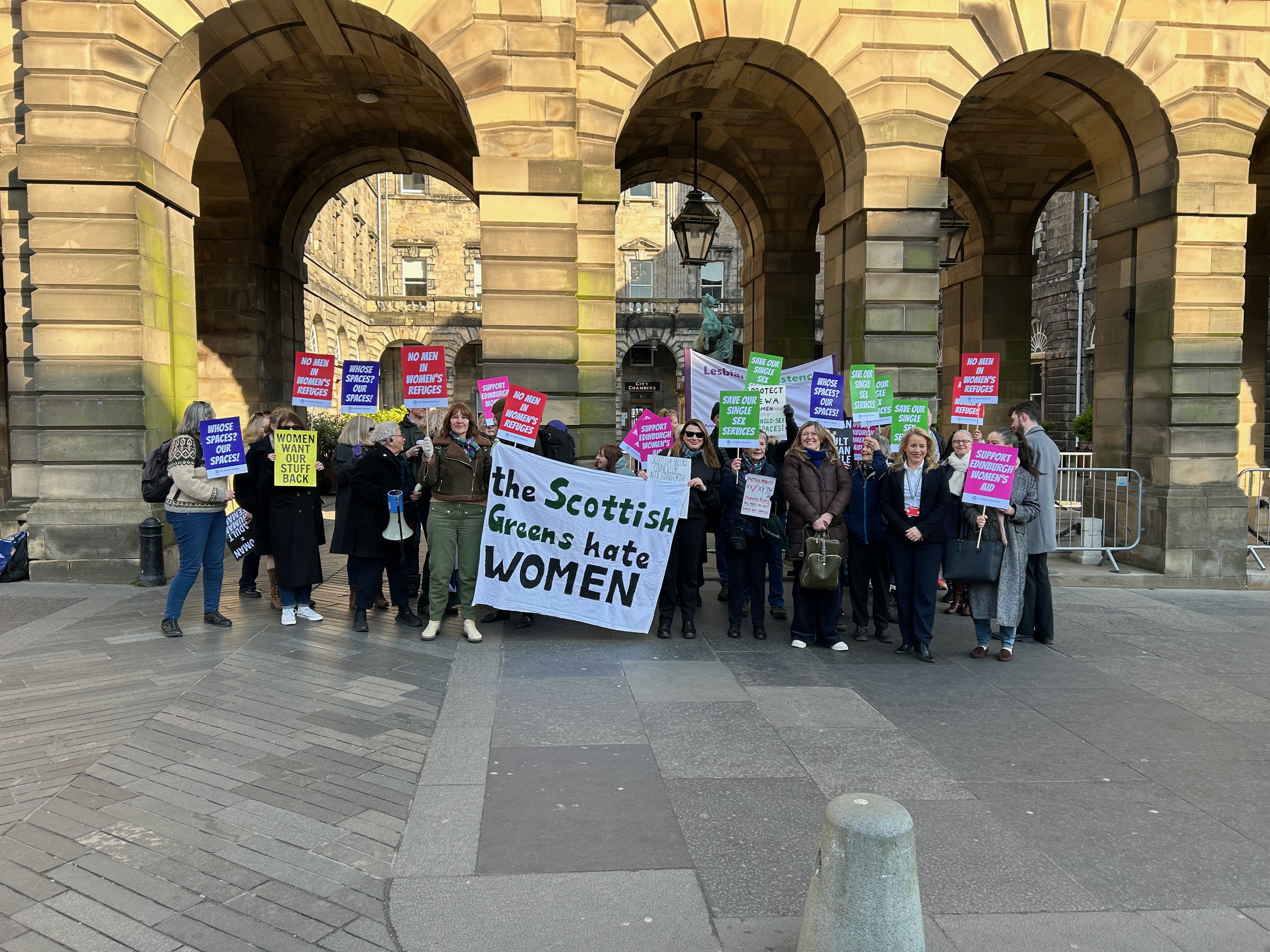
The motion was debated at the full meeting of the Council on 20 March. Prior to the meeting commencing, there was a rally outside City Chambers organised by For Women Scotland. The rally was addressed by Council leader Jane Meagher, who revealed that she had been involved in the campaign to establish EWA in the 1970s.
Amended motion
Councillors from other political parties tabled several amendments to the motion. In the end, councillors voted in favour of a composite amendment from the SNP and Liberal Democrat groups (38 for the motion, 22 against). This asked officials to list what support already exists in the city and “any identified gaps in this provision”, whilst informing EWA that they must explain how they will include trans-identified males in the service they offer.

Evidence base for the gap in service provision
We decided to submit two freedom of information (FOI) requests to the Council. The first request asked the Council to “provide copies of all information and research held by the council regarding the incidence of domestic abuse experienced by individuals with transgender identities”.
The Council responded initially, on 18 March, seeking clarity about the request. The response stated: “We cannot identify the information you have requested from the details you have provided. To help us meet your request, could you please confirm what individuals you are referring to. Is this members of staff, social work clients etc.”
We responded saying: “Given that the council seeks to fund services for individuals in the city who have experienced domestic abuse, I am trying to understand what evidence base the council has on the incidence of domestic abuse experienced by those with transgender identities (who might therefore need services).”
The Council then responded, on 16 April, saying: “Unfortunately, we are unable to provide you with the information requested because it is not held by the Council.”
The second request asked: “How many bids for funding has the council received over the past ten years from groups and organisations seeking to set up domestic violence refuges and other services for (1) men and (2) those with transgender identities. Please provide this figure broken down by year.”
The Council responded, on 15 April. It stated:
Unfortunately, we are unable to provide you with the information requested because it is not held by the Council. The City of Edinburgh Council has never procured a domestic abuse service for men or transgender people, nor have we been approached by any service wishing to provide this on behalf of the Council so no bids have been received.
Bringing clarity: UK Supreme Court ruling
The other development that has taken place since the motion was debated and voted on is that the UK Supreme Court has ruled that the definition of ‘sex’ in the Equality Act 2010 means biological sex and confirmed that the definition of ‘woman’ does not include any men, even those with Gender Recognition Certificates. This has brought much-needed clarity to organisations operating single sex services for women, including domestic violence refuges and rape crisis centres.
As we said in our quote in The Times article, which reported the FOI responses above:
“Men’s violence against women is at epidemic levels and resources for services which support women who have experienced domestic abuse are under huge pressure. Instead of seeking to siphon off a portion of the limited resource a women-only service has, councillors should be producing an evidence-based case for bespoke funding for services for men, including those with trans identities, who have experienced domestic abuse.”
Scottish Human Rights Commissioner and human rights expert Dr Claire Methven O’Brien has further pointed out that a failure to provide single sex domestic violence refuges is inconsistent with the requirement to provide separate-and single sex services for survivors of violence against women, under the Council of Europe Istanbul Convention, ratified by the UK in 2022.
Conclusion
The Council is committed to making Edinburgh a city which prioritises the safety of women and girls. Enabling the provision of single sex domestic violence refuges for women is an essential part of that commitment.
From the information now disclosed by the Council, it is clear that the challenge to Edinburgh Women’s Aid funding had no evidence base. Moreover, it threatened vital services for women in the city, based on the well-established need for single-sex provision for women subject to domestic abuse.
It is unclear whether or not Cllr Staniforth approached Council officials before lodging his motion. Had he done so, he would have quickly established that the Council held no information on the need for domestic violence refuge services for those with transgender identities. Nor has any organisation approached the Council to seek funding for such a service in the last ten years.
As noted above, the amended motion did not commit the Council to establishing an evidence base for the need for such services. This is an unfortunate omission. Key decisions about funding for vital services need to be supported by robust evidence, and not, as in it appears in the case of Cllr Staniforth’s motion, opposition to single sex spaces for women (as defined by biological sex) as a matter of party political position.